From Legacy Burden to Leadership Mode: PNB’s Growth Phase
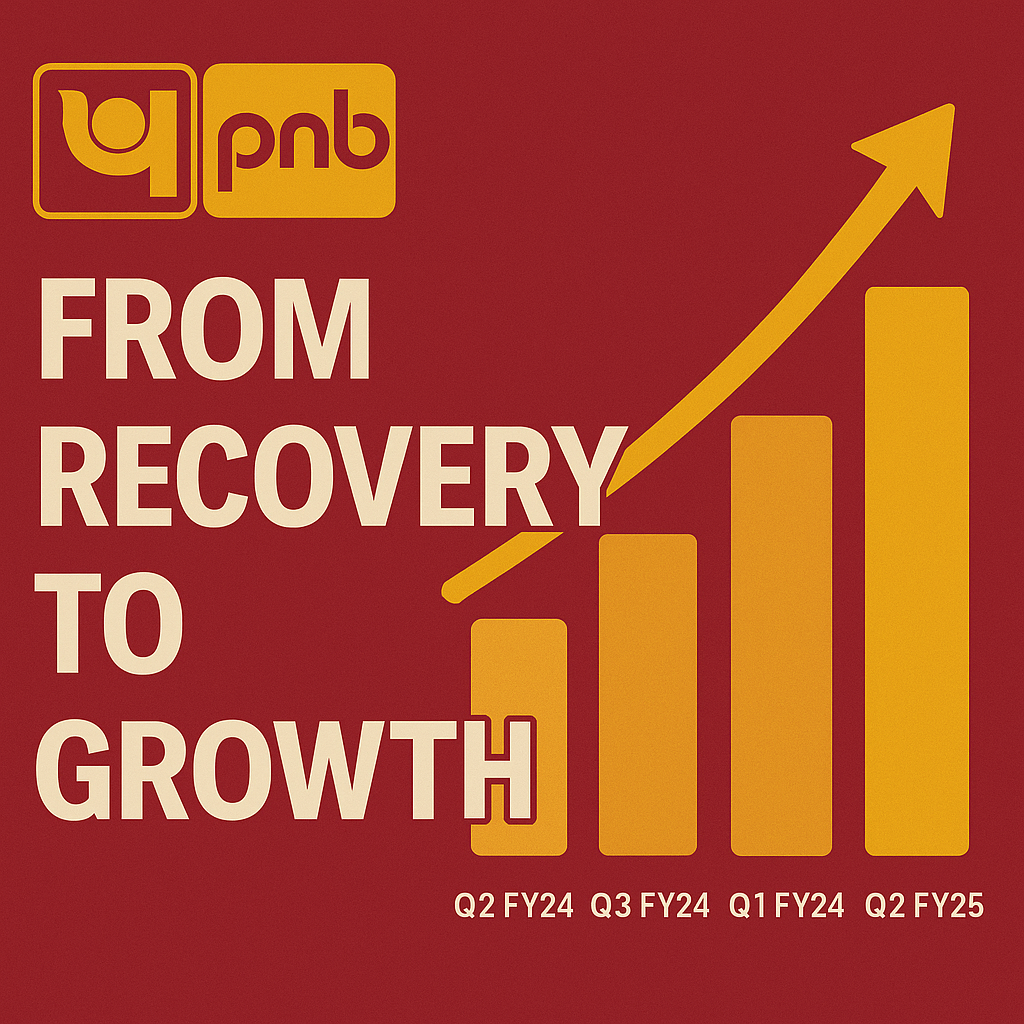
Over the course of the last five quarters, Punjab National Bank has transitioned from a cautious recovery story to a confident, growth-oriented institution.
In Q2 FY24, the bank's tone was defensive and grounded in legacy challenges, particularly high NPAs and credit costs. While it posted record profits, management remained focused on clean up, deposit repricing concerns, and restoring capital adequacy. The narrative emphasized potential improvements, but lacked quantifiable forward guidance.
By Q3 and Q4 FY24, PNB entered a more stable execution phase. Profitability surged, asset quality metrics improved significantly, and capital adequacy began to strengthen. The management tone shifted from hopeful to confident, supported by consistent operational performance and better provisioning. Strategic commentary began to highlight sustained performance rather than one-off improvements.
In Q1 and Q2 FY25, the bank fully pivoted into expansion and strategic clarity. Not only did net profits rise materially quarter-on-quarter, but asset quality continued to strengthen with credit costs dropping sharply and new underwriting quality visibly improving. Capital adequacy crossed 16% for the first time, freeing management to focus on return ratios and digital-led business expansion. Guidance also became more specific and outcome-driven including clear NPA, ROA, and credit cost targets.
The overarching tone today is forward-looking and conviction-driven. PNB is no longer focused on recovery, it's positioning itself as a scaled, disciplined, and digitally progressive institution. The risks remain, especially around fee income competition, but the dominant message now is that of a public sector bank with a clean book, solid earnings momentum, and a well-articulated path forward.
Narrative has evolved meaningfully over the last five quarters.
In Q2 FY24, the tone was cautious, focused on legacy NPA issues and capital rebuilding.
By Q3–Q4 FY24, performance improved with strong profit growth and better asset quality, shifting the tone to confident execution.
Here is a breakdown of how Punjab National Bank’s (PNB) performance has evolved and how that shift is reflected in the language, metrics, and narrative from Q2 FY24 to Q4 FY25:
Evolution of PNB's Performance and Tone (Q2 FY24 to Q4 FY25)
1. Asset Quality
Then (Q2 FY24):
Management acknowledged legacy high NPA issues.
Gross NPA stood at 6.96%, Net NPA at 1.47%.
Credit cost was a high 1.31%, indicating ongoing stress.
Now (Q2 FY25):
Gross NPA reduced to 4.48%, Net NPA to 0.46%.
Credit cost dropped sharply to 0.08%, with new underwriting NPAs at just 0.30%.
PCR has improved from 94% in Q3 to 95.90%+, reflecting improved provisioning buffers.
Interpretation:
The bank has effectively contained slippages and cleaned up its book, turning asset quality from a problem statement into a proof point. The narrative moved from "confidence in reduction" to firm guidance on further improvements (targeting 3.5 - 3.75% GNPA by March 2025).
2. Profitability
Then:
Q2 FY24 net profit was ₹1,756 Cr.
Management celebrated it as a “record high” but sounded cautious about structural pressures.
Now:
Q4 FY25 net profit is ₹4,567 Cr (YoY growth of 51.7%).
ROA hit 1.02%, up 25 bps YoY.
Net Interest Income (NII) grew to ₹10,757 Cr (up 3.8%).
Interpretation:
Profit growth is now multi-quarter, consistent, and margin-supported. Earlier quarters highlighted profit spikes; now the tone reflects profit compounding with stable fundamentals (e.g., NIM guidance of 2.9–3% is sustained).
3. Capital Adequacy
Then:
CET-1 stood at 10.23% in Q2 FY24.
Commentary included “slight improvements” but concern over deposit repricing.
Now:
Capital adequacy exceeded 16%, CET-1 at 11.59%.
Management signaled readiness to raise more capital proactively if rates are favourable.
Capital now positioned as an enabler of shareholder returns.
Interpretation:
Earlier, capital was a compliance requirement; now it’s a strategic asset supporting growth and improving investor confidence. The tone moved from “meeting norms” to capitalizing on growth.
4. Business Growth
Q4 FY25 Metrics
Global business up 14.03% YoY to ₹26.8 lakh Cr.
Deposits up 14.38%, Advances up 13.56%.
RAM advances (Retail, Agri, MSME) up 15.89%, led by MSME & current account additions.
Interpretation:
Earlier, growth commentary was tied to "recovery"; now the bank is using phrases like "successful expansion strategy" and highlighting digital journeys. The tone is transformational, not transactional.
5. Strategic Guidance
Then:
ROA guidance was vague (\~0.8%), asset quality goals were qualitative.
Focus areas included HR transformation, CASA improvement, etc.
Now:
ROA guidance upgraded to 0.9–1%, Gross NPA guidance: 3.5–3.75% by March 2025.
Credit cost outlook revised from 1% → 0.5% → now 0.25–0.30%.
Strategic focus on digital MSME journeys, platform modernization, and account expansion.
Interpretation:
The guidance has evolved from aspirational to numerical and accountable. There’s a sense of target-driven execution, replacing the earlier narrative of system clean-up.
6. Risks and Competitive Context
Risks around asset quality and intense fee income competition are mentioned, but with a lighter touch.
The dominant message has shifted from risk management to opportunity capture.
Powered by CompoundingAI — AI research platform for Indian stocks, every claim cited from primary filings
Login Now